Art As Commerce
by Kailash Khandelwal
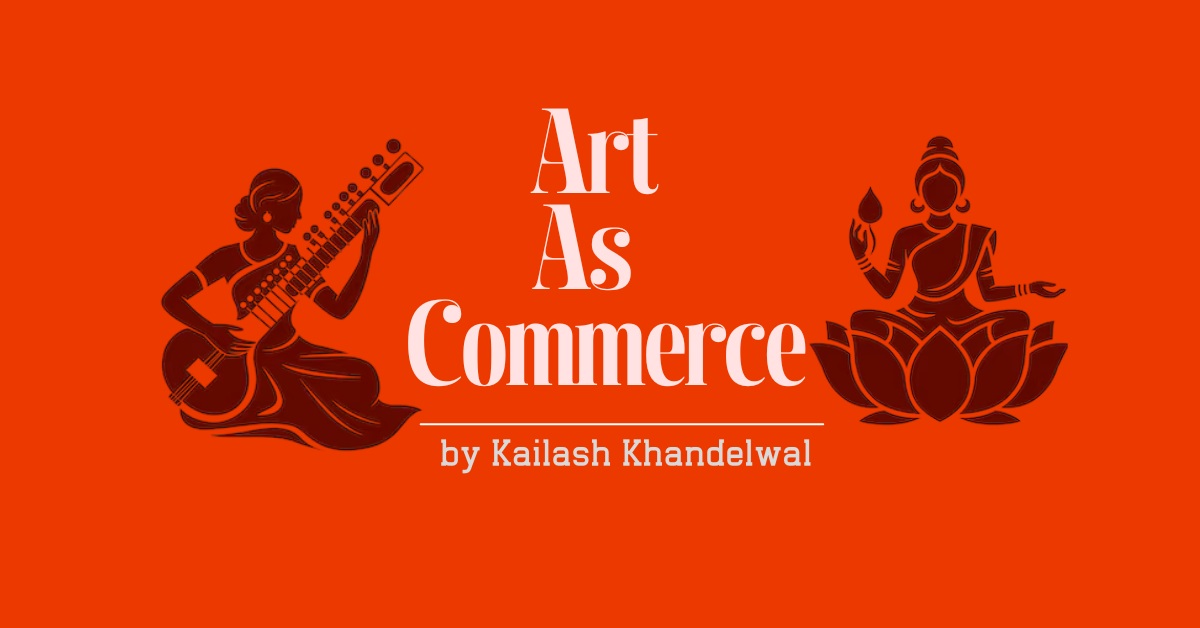
From early childhood, I had absorbed the belief that artists belonged to the
world of Goddess Saraswati — creative, gentle, humble, and far removed from
the material pursuit of commerce and money, which belonged to the realm of
Goddess Lakshmi. Growing up in the midst of a business family and relatives
whose lives were shaped by commerce only reinforced this idea in me:
Saraswati and Lakshmi lived in separate worlds, and never the twain shall
meet.
The first artist I observed closely as a child was a music teacher arranged
to give lessons to my sister, more as a customary requirement for
matrimonial prospects than as any serious musical pursuit. I would sometimes
accompany her to the nearby school where he taught in the evenings, and
there I watched, fascinated, as his fingers seemed to glide and dance across
the harmonium. In many ways, he helped shape my early image of a “Saraswati putra” — a man touched by creativity, yet thin, bony, and almost oblivious to proper dress.
.
Once a week, he would visit our home, where my mother served him homemade
delicacies prepared in desi ghee. Even as a young boy, I noticed his obvious
craving for the delicacies, which felt awkward to me. It ran contrary to my
childish idea of a “Saraswati putra,” someone I imagined to be above such
ordinary desires.
As I came to know him a little more, I began to notice other details. He
looked almost sickly and carried a strange, unpleasant odor around him.
Later, when I entered my family business, I still found time to contribute articles to a few local dailies. This brought me into contact with another kind of “Saraswati putra” — artists of the written word: local editors, writers, journalists, and poets.
The closer I came to their world, the more serious cracks appeared in my romantic image of them. I began to see ordinary human desires and pettiness — not very different from the world of commerce and money I had grown up around.
I found that jealousy, greed, petty rivalries, and crude habits often lived
comfortably beside creative and writing skills. Their instinct for finding
money-making opportunities was equally visible, sometimes in ways that felt
crude and unbecoming.
When I moved to the USA, my interaction with the world of artists expanded further. I got a chance to observe artists from close quarters — stage performers, painters, dancers, musicians, Bollywood stars, classical singers, and performers of many shades, from pop and hip-hop to religious and not-so-religious forms of art.
My already dwindling impression of artists did not fail me this time either. I was no longer surprised to find the same weaknesses — jealousy, rivalry, pettiness, ego, strong money concerns, and even greed — coexisting quite comfortably with artistic talent.
. The
distance between art and commerce, which I had once imagined to be so wide,
narrowed even further.
Having too often seen the mundane side of artists dwarfed by the lofty ideals their art claimed to represent, I no longer place them on a high pedestal.
Still, I genuinely feel good that many artists today are financially better
off than the struggling artists I had observed over the years.
During my last visit to my small town in India after a long gap, while we
were catching up on old news, someone mentioned in passing that the music
teacher I might remember had died abruptly from some minor illness. The news
broke my heart, though I kept my feelings to myself.
On my flight back to the USA, my mind kept returning to the music teacher —
and with that, to his body odor that had once made me quietly uncomfortable.
For quite some time now, I have understood that it came from his inability
to afford regular baths or afford regular washing of his clothes.
Kailash is the publisher of USADunia.com and AtlantaDunia.com