Indian Parallel Cinema. Still Going Strong?
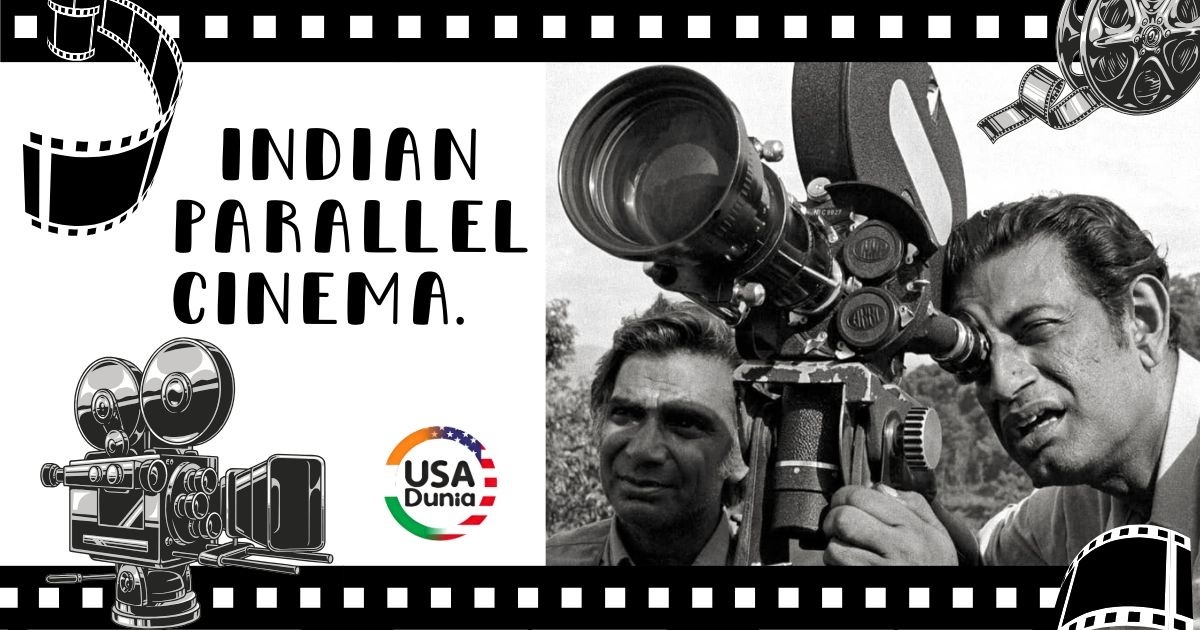
By Mahadev Desai
Parallel Cinema, also known as Indian New Wave or Alternative Cinema, is a
film movement in India that emerged in the 1950s as an alternative to
mainstream commercial cinema. It originated in West Bengal and was heavily
influenced by Italian Neorealism and, to a lesser extent, the French New
Wave.
The movement arose during India’s post-independence period, when filmmakers
sought to reflect the realities of a rapidly changing society. Inspired by
Vittorio De Sica’s Bicycle Thieves (1948), a realistic portrayal of poverty
and the resilience of the human spirit, and Jean Renoir’s The River, a
lyrical and visually rich film set along the Ganges, Indian directors aimed
to move away from melodrama, song‑and‑dance sequences, and star‑driven
narratives of formulaic mainstream films.
Early pioneers of the New Wave included Satyajit Ray, Ritwik Ghatak, Mrinal
Sen, Tapan Sinha, and Bimal Roy.
Although Bengal was the cradle of the movement, Parallel Cinema also
flourished in other regions — notably in Kerala, Karnataka, Maharashtra, and
Andhra Pradesh. Filmmakers such as Adoor Gopalakrishnan, Girish Kasaravalli,
Aravindan, John Abraham, and Jabbar Patel made significant contributions.
Due to space constraints, this report highlights only a few representative
figures.
Realism and Naturalism — Use of natural lighting, non‑professional actors,
and real locations to create authentic settings.
Relatable Social and Political Themes — Focus on poverty, caste
discrimination, gender inequality, communal disharmony, women’s
objectification and subjugation, post‑independence struggles of marginalized
communities, rural‑to‑urban migration, and the effect of Partition on
Muslims (e.g., M.S. Sathyu’s Garm Hawa); Ketan Mehta’s Mirch Masala about
the resilience of rural women.
Artistic Integrity — Minimal use of music and glamour; emphasis on
intellectual and emotional depth; plots often based on insightful Indian
literature.
Modest Budgets — Films were made with limited resources, allowing creative
freedom. Funding came from the Film Finance Corporation and later the
National Film Development Corporation (NFDC).
Major Filmmakers and Works
Satyajit Ray — Pioneer of Parallel Cinema; directed more than 30 films
including the Apu Trilogy, Charulata, and The Music Room.
Ritwik Ghatak — Known for his Partition Trilogy: Meghe Dhaka Tara, Komal
Gandhar, Subarnarekha.
Mrinal Sen — Celebrated for Bhuvan Shome, Ek Din Pratidin, Akaler Sandhane.
Shyam Benegal — Explored caste, class oppression, poverty, and feudal power
structures. Notable works: Ankur, Nishant, Manthan.
Adoor Gopalakrishnan — Pioneer of the Malayalam New Wave; known for
Swayamvaram, Elippathayam, Vidheyan.
M.S. Sathyu — His Garm Hawa (1973) marked a milestone in Hindi/Urdu Parallel
Cinema.
Govind Nihalani — Tackled political and human‑rights issues in films like
Aakrosh, Ardh Satya, Drishti.
Tapan Sinha — Made acclaimed films in Bengali, Hindi, and Oriya, including
Sagina Mahato, Kabuliwala, Upahar.
Parallel Cinema became a voice for the marginalized, offering unfiltered
reflections of Indian society. It was supported by the Film Finance
Corporation (1960), the Film Institute of India (1961), and later the NFDC,
which provided funding, distribution support, and cultural preservation. The
movement also flourished during politically charged periods, such as the
Emergency (1975–77), when cinema became a tool for social critique.
While it never achieved mass commercial appeal due to limited entertainment
value, financial constraints, and competition from television, Parallel
Cinema profoundly influenced Indian storytelling. Its works remain studied
for their cultural and historical significance, and its ethos continues to
influence contemporary Indian cinema.
Modern Bollywood has evolved dramatically. Some defining traits include:
High‑budget spectacle — Large‑scale sets, CGI, and action sequences aimed at
global audiences.
Star‑driven franchises — Reliance on bankable actors and recurring cinematic
universes.
Hybrid genres — Blending romance, comedy, action, and music into a single
narrative.
Globalized themes — Stories set abroad, NRI characters, and Westernized
aesthetics.
Music‑centric marketing — Songs released months before the film to build
hype.
Escapism — Preference for glamour, fantasy, and emotional upliftment over
realism.
Impact of Streaming Platforms on Parallel Cinema
Streaming platforms such as Netflix, Amazon Prime, SonyLIV, and MUBI have
had a mixed but largely positive impact on Parallel Cinema:
Wider accessibility — Classic and contemporary art‑house films are now
available globally, reaching younger audiences who never saw them in
theatres.
Revival of interest — Platforms curate retrospectives of Ray, Ghatak,
Benegal, and others, renewing appreciation for their work.
New wave of indie filmmakers — Streaming has reduced dependence on
box‑office success, enabling realistic, low‑budget storytelling reminiscent
of the original movement.
Competition from binge‑worthy content — At the same time, fast‑paced global
series and commercial films can overshadow slow‑burn, contemplative cinema.
Overall, streaming has not diminished Parallel Cinema — it has preserved,
revived, and expanded its audience, even if it competes with more commercial
content.
In conclusion, the writer has watched some of the above movies and strongly
urges movie-lovers to watch ‘parallel movies’ and enjoy its real flavor.