Is Astrology a Science?
It did not take me long to realize that people
hold stubborn views about astrology.
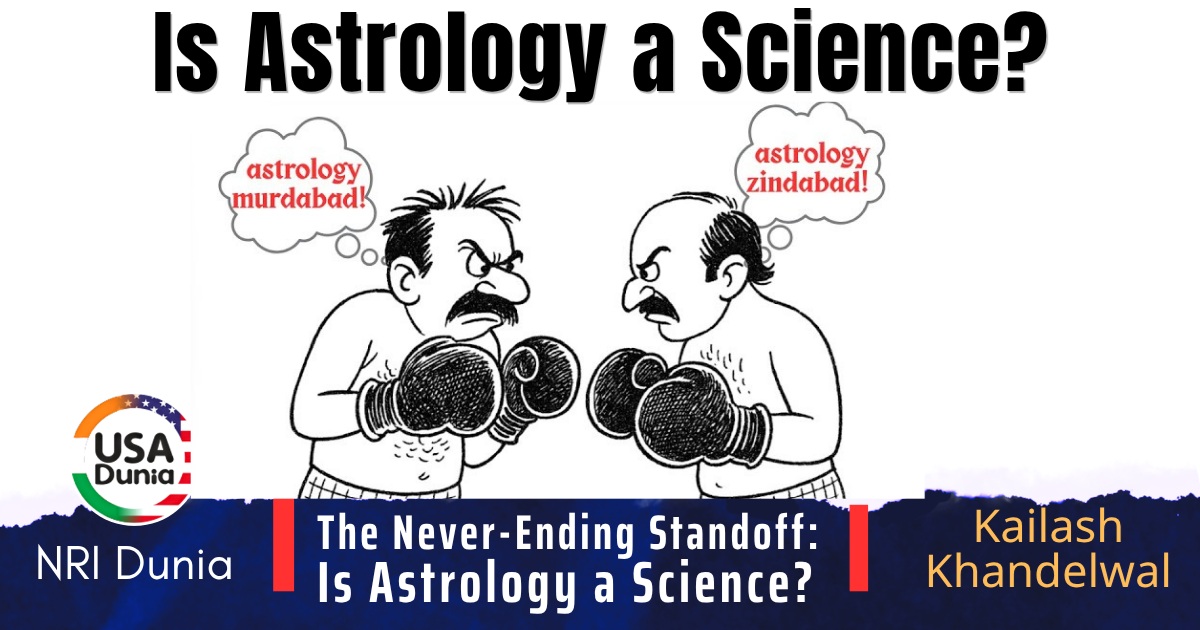
by Kailash Khandelwal
Once, while traveling to Mumbai with members of my astrology study group, we
got into a conversation with two co-passengers who happened to be science
teachers. The topic was the familiar one: Is astrology a science?
Soon the lines were drawn, and the discussion turned bitter.One of my
study-group members — my cousin — took it upon himself to prove that
astrology is a science. In our circle, his horoscope and his conduct alike
reflected a very strong Mars on the fixed-sign cusp — unyielding fixity with
Martian intensity.
Unfortunately, the other side also seemed to be having a strongly Martian
day. For a moment, it looked as if the question would be settled not by
argument, but by a small brawl. I had to step in and cool things down.
I have faced this question many times, often from intelligent people who are
strongly opposed to astrology.
So, is astrology a science?
If the question is whether astrology is like the exact sciences —
mathematics, physics, chemistry, and so on — then my answer is no.
For many defenders of astrology, the idea of planetary gravitational pull
remains the preferred explanation. I too once found such arguments
persuasive—they sound scientific, and at first glance they feel sufficient.
But many years ago, I became deeply interested in the foundational questions
asked by modern science itself. Since then, one of my favorite lines has
been a slight adaptation of Niels Bohr: If you are not shocked by modern
science, you have not understood it. In that light, I now feel embarrassed
by the old gravitational-pull defense of astrology. The explanation began to
look trivial, childish, and not convincing at all. There is no way I could
meaningfully relate gravitational pull to divorce, no marriage, or
multiple-marriage yogas in a horoscope.
The after-effect of this was that I stayed mostly silent on the question of
how astrology works. Not because I lacked personal, empirical faith in it.
But because I lacked an explanation that satisfied my own mind.
It took me many years to arrive at one. Oddly enough, modern science helped
me the most. Today, I feel much more assured that astrology can be better
explained through the idea of emergence. But it deserves a separate article.
Astrology gave me the opportunity to glimpse into the lives of hundreds of
people through the window of their horoscopes. Sharing in their trials and
tribulations, their successes and failures, I found myself facing certain
perpetually unanswerable questions. Destiny. Fate. Free will. Determinism.
Karma. Causation. Astrology became, for me, a stepping stone to a
self-initiated journey toward Vedanta.
Explaining astrology through the idea of emergence cannot be done casually,
and I am quite choosy about whom I explain it to. As a result, the old
gravitational-pull logic continues to be widely used, even in my study
group, to validate astrology.
When we finally got off the train, my cousin came to me and said, with full
seriousness, that he had mentally cast the horoscope of the moment and
concluded that our science-teacher co-passengers were clearly going through
a bad period.
Then he added, “You should not have intervened. Two tight slaps would have
been enough to convince them that astrology is science.”
Kailash has been practicing astrology for
many years. Through his portal, JyotishPortal.com , he has been freely
sharing his knowledge with thousands of students around the world. He is
also the publisher of USADunia.com and AtlantaDunia.com